


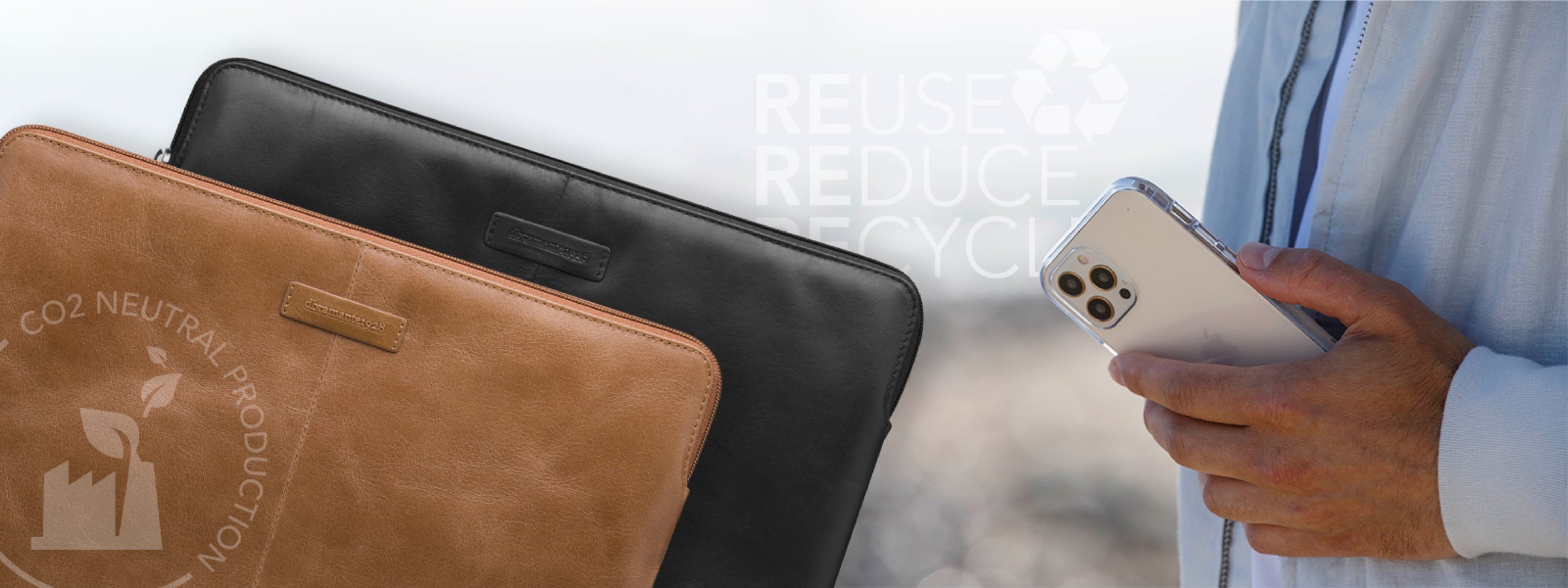
Recycled plastic
Have you thought about the global environmental impact of plastic phone cases? Almost every smartphone comes with a phone case. Taking that into consideration, it’s no wonder that over 2 billion plastic phone cases are sold each year. Unfortunately, many of those cases are made from single-use plastics and end up in landfills, or worse, our oceans.
We work to reduce plastic pollution by replacing single-use plastic products with products made from recovered and recycled plastic materials.
Certified recycled materials
Our products made with recycled plastic are verified by GRS (Global Recycled Standard) – a voluntary product standard for tracking and verifying the content of recycled materials in a product. With the GRS certification, you can be sure that our products hold both a verified recycled content of the product certification and a verified responsible social, environmental, and chemical practices certification of their production.
Full-grain leather
All of our leather products are made from full-grain leather, which is the finest quality form of leather and the strongest. Due to the material’s durability, full-grain leather prolongs the product life cycle, which is an important step to saving on resources and thereby minimising the environmental footprint. It also ensures a product that will not only last a long time but also look great for ages, as it develops a beautiful patina with time.
All of the hides we use as raw-material are by-products from the meat and dairy industry that would otherwise go to waste.
Why not plant-based plastics
Given the volume of plastic already in circulation, increasing the collection and recycling of existing materials is a necessary part of addressing plastic waste. For this reason, we currently use recycled plastic for our products rather than bioplastics.
Plastic is persistent and does not readily break down in the environment, which makes waste management a long-term issue. In many regions, infrastructure for collecting and recycling conventional plastic is already established, while systems for handling biodegradable or biobased plastics are still limited.
Bioplastics also present challenges. Many products marketed as bioplastics are not fully bio-based or biodegradable, and may include conventional fossil-based plastics to achieve required material properties. Their degradation depends on specific conditions, which are often not met in natural environments or standard waste systems.
In addition, bioplastics are produced from biological feedstocks, and evaluating the environmental impact of these inputs is complex. According to WWF, there is no clear classification of “sustainable” versus “unsustainable” feedstocks due to trade-offs in land use, resource use, and other factors.
Get more information about why recycling plastic should be the priority and the challenges regarding bioplastics here and here.